

DNA vs Epigenetics: What’s the Difference and Why Does It Matter?
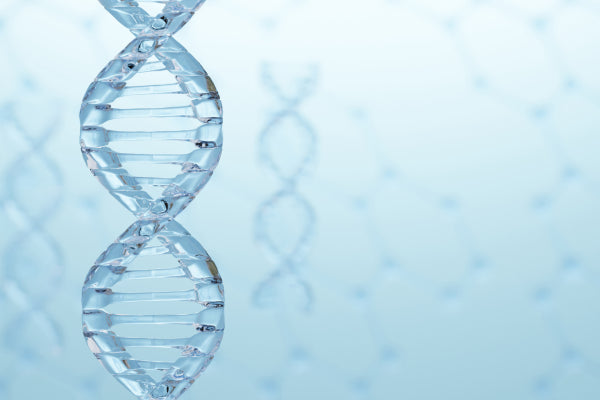
You were born with your DNA. But how you live decides which parts of it get used.
That’s the simplest way to understand the difference between genetics and epigenetics, and why it matters so much for how you age.
Your DNA: the instruction manual
Almost every cell in your body carries a complete copy of your DNA. Think of it as an instruction manual for building and running you. It’s made up of around 20,000 genes, each one a set of instructions for a specific job, such as:
- Building muscle and repairing tissue
- Processing vitamins and minerals from your food
- Producing hormones
- Controlling how your hair grows
- Managing inflammation
Your DNA is inherited, half from each parent, and it stays the same for your whole life. A genetic test reads this manual and shows your predispositions: the areas where your body may be more or less likely to run into trouble. For example, it can show whether you carry a variant that makes it harder to process certain B vitamins, or one linked to hair loss.
But here’s the key point. Having a gene doesn’t mean it’s being used.
Gene expression: which instructions are switched on
Every cell has the full manual, yet a skin cell behaves very differently from a brain cell. That’s because each cell only reads the instructions it needs and ignores the rest.
This process of turning genes on and off is called gene expression. And it doesn’t stay fixed. Throughout your life, genes are switched on and off in response to what’s happening in and around your body.
That’s where epigenetics comes in.
Epigenetics: the switches on top of your DNA
“Epi” means “on top of”. Epigenetics is a layer of control that sits on top of your DNA and decides which genes are active, without changing the genes themselves.
If your DNA is the manual, epigenetics is the set of sticky notes and highlighter marks telling your body which pages to read and which to skip.
Methylation: how the switches work
The best-understood epigenetic switch is DNA methylation. Here’s how it works:
- Tiny chemical tags, called methyl groups, attach to specific points on your DNA.
- When a tag sits on or near a gene, it usually turns that gene down or off.
- When the tag is removed, the gene can switch back on.
Your body adds and removes these tags constantly. And the overall pattern of tags across your DNA changes in a predictable way as you age.
How your lifestyle changes your biology
Here’s what makes epigenetics so exciting: your methylation patterns respond to how you live. Research has linked them to:
- Diet: nutrients such as folate and B12 are directly involved in the methylation process
- Smoking: one of the strongest and best-documented influences on methylation
- Alcohol: heavy drinking leaves a measurable epigenetic mark
- Sleep: poor sleep is associated with faster epigenetic ageing
- Stress: long-term stress affects the genes that control your stress response
- Exercise: regular movement is linked to healthier methylation patterns
Identical twins show this perfectly. They’re born with the same DNA, yet as they grow older their epigenetic patterns drift apart, shaped by different diets, habits and environments. Same manual, different sticky notes.

Biological age vs your age on paper
Because methylation patterns shift as we age, scientists have built models called epigenetic clocks. By reading your tags at specific points on your DNA, a clock can estimate your biological age: how old your body really is, as opposed to the number on your passport.
Two people born on the same day can have very different biological ages. One might be ageing faster than their years, the other more slowly.
And because epigenetics responds to lifestyle, your biological age isn’t set in stone. Retest after six months of better sleep, a better diet or less stress, and you can see whether the changes are making a difference.

Why your sex matters
Men and women age differently. They have different hormones, different methylation patterns and a different pace of ageing.
Yet most epigenetic clocks were built from mixed male and female data, so they compare you with an average of the two. That’s like a clothing size chart made by averaging men’s and women’s measurements. It fits nobody properly.
That’s why Harley Longevity Club uses the world’s first sex-specific tests. The women’s clock was built only on women, using samples from 8,436 women, and the men’s clock was built only on men. Your result compares you with your own sex, so it reflects your biology, not an average.
DNA vs epigenetics at a glance
| DNA (genetics) | Epigenetics | |
|---|---|---|
| What it is | Your instruction manual | The switches that turn genes on and off |
| Does it change? | No, fixed for life | Yes, throughout your life |
| What shapes it | Your parents | Your lifestyle and environment |
| What it tells you | Your predispositions | How your body is ageing now |
| Can you act on it? | It guides what to focus on | It shows whether what you’re doing is working |
Why you need both
On its own, a DNA test tells you where your risks lie. An epigenetic test on its own tells you how you’re ageing, but not why. Together, they give you the full picture:
- Your DNA shows what you were born with.
- Your epigenetics shows what you’re doing with it.
- Retesting shows whether your changes are working.
Start with one simple test
The Harley Longevity Club DNA and epigenetic test reads both from a single saliva sample taken at home. You’ll receive 10 personalised reports, your biological age, and practical guidance on what to change, using a clock built for your sex.
Your genes are where you start. What happens next is up to you.

At Harley Longevity Club, the test is only the beginning
How far you go is entirely up to you.
- Take the test once. Get your results, your biological age and your personalised reports, and stop there if you wish.
- Retest every 6 months. See whether your results have improved and whether your biological age has come down.
- Join the longevity ecosystem. Let us become the concierge of your health, across every area of your life and your family's life.
We do things a little differently here. We're not about generic healthcare. We're about care tailored to you. Alongside our diagnostics, we offer regenerative medicine and Ayurvedic medicine, bringing the best of eastern and western approaches together.
Your results tell us everything we need to build your plan. From there, you choose how to use us: become a member, or simply come in whenever you please.
This is the new era of healthcare. Your health is the new luxury.
Begin with the test.